
ADVERTISEMENT
🍮 Expanded Recipe: Creamy Butter Pecan Fudge
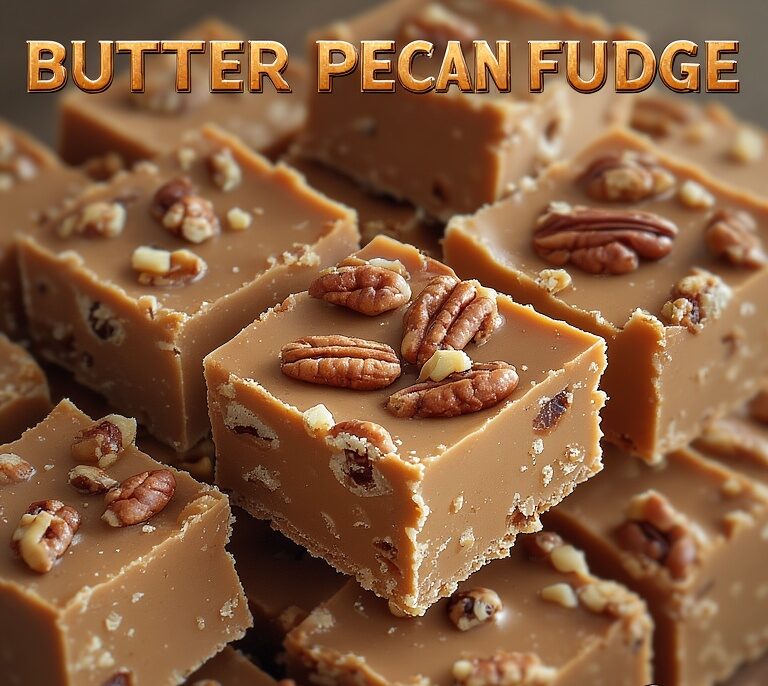
This recipe delivers a smooth, decadent, old-fashioned fudge with a rich buttery flavor and a satisfying crunch from toasted pecans.
Ingredients
For the Toasted Pecans:
-
$1$ cup (100g) pecan halves or pieces
-
$1$ tablespoon unsalted butter, melted
For the Fudge:
-
$2$ cups (400g) granulated sugar
-
$\frac{3}{4}$ cup (180ml) evaporated milk (not sweetened condensed milk)
-
$\frac{1}{2}$ cup (115g) unsalted butter (cut into large pieces)
-
$\frac{1}{4}$ teaspoon salt
-
$1$ teaspoon pure vanilla extract
-
$7$ ounces (200g) marshmallow fluff (or approx. 2 cups mini marshmallows)
Instructions
1. Toast the Pecans
-
Preheat your oven to $350^\circ\text{F}$ ($175^\circ\text{C}$).
-
Toss the pecan halves/pieces with $1$ tablespoon of melted butter.
-
Spread the pecans in a single layer on a small baking sheet.
-
Bake for $8$ to $10$ minutes, stirring once halfway through, until they are fragrant and lightly golden brown. Watch carefully to prevent burning.
-
Once toasted, remove them from the oven and set them aside to cool completely.
2. Prepare the Pan
-
Line an $8 \times 8$ inch ($20 \times 20$ cm) baking pan with parchment paper, leaving an overhang on two sides to easily lift the fudge out later.
-
Lightly grease the parchment paper with butter or non-stick spray.
3. Cook the Syrup Base
-
In a heavy-bottomed $3$ or $4$-quart saucepan, combine the granulated sugar, evaporated milk, $\frac{1}{2}$ cup of butter pieces, and salt.
-
Place the pan over medium heat and stir constantly until the butter is melted and the sugar is completely dissolved.
-
Stop stirring and bring the mixture to a rolling boil. Continue to boil the mixture without stirring.
4. Achieve Soft-Ball Stage
-
Use a candy thermometer clipped to the side of the pot (ensure it does not touch the bottom) and boil until the mixture reaches the soft-ball stage, which is $234^\circ\text{F}$ to $238^\circ\text{F}$ ($112^\circ\text{C}$ to $114^\circ\text{C}$). This usually takes $5$ to $8$ minutes.
-
If you do not have a thermometer: Drop a small amount of the boiling mixture into a cup of cold water. If it forms a soft, pliable ball that can be flattened between your fingers, it has reached the soft-ball stage.
5. Mix the Fudge
-
Immediately remove the saucepan from the heat once it reaches the correct temperature.
-
Add the marshmallow fluff (or mini marshmallows) and the vanilla extract directly into the hot mixture.
-
Using a rubber spatula, stir vigorously until the marshmallow fluff is completely melted and the mixture is smooth and uniform. This should only take about $1$ minute.
-
Quickly fold in the cooled, toasted pecans.
6. Set and Cool
-
Immediately pour the hot fudge mixture into the prepared $8 \times 8$ inch pan.
-
Use the spatula to quickly spread and smooth the top evenly.
-
Let the fudge cool completely at room temperature for at least $4$ hours, or chill it in the refrigerator for $2$ hours until it is completely set and firm.
-
Once set, use the parchment paper overhang to lift the fudge block out of the pan.
-
Slice the fudge into small $1$-inch or $1 \frac{1}{2}$-inch squares for serving. Store in an airtight container.
The Southern Charm of Butter Pecan Fudge
Fudge: The Sweet Science of Crystallization
Fudge is a confectionery characterized by its soft, rich, and creamy texture, distinguishing it from harder candies like toffee. Its creation is a delicate balance of science and speed, centered around the control of sugar crystallization.
The core process of fudge making involves cooking sugar, milk, and butter to a precise temperature, specifically the soft-ball stage ($234^\circ\text{F}$ to $238^\circ\text{F}$). This temperature ensures that when the mixture cools, the sugar molecules will form numerous tiny, fine crystals, resulting in the desired smooth and creamy texture. If the mixture is cooked too long (beyond the soft-ball stage), the resulting crystals will be larger, creating grainy fudge.
The modern method, popularized by recipes like this one, incorporates marshmallow fluff or marshmallows. Marshmallows contain gelatin or corn syrup, which acts as a sugar stabilizer, helping to prevent large crystal formation and ensuring a consistently smooth, foolproof batch of fudge.
The Decadent Flavor Profile: Butter Pecan
While chocolate is the most common fudge flavor, Butter Pecan taps into a tradition of rich, brown-sugar-based confections beloved in the Southern United States. The flavor is a sophisticated blend of:
-
Toasted Nut Flavor: Pecans, when toasted, release their natural oils, intensifying their sweet, nutty, and slightly earthy flavor. This crucial step prevents the nuts from tasting raw or bland inside the dense fudge.
-
Caramelized Butter: The combination of butter and sugar, cooked to a high temperature, results in a deep, nutty, and slightly caramelized flavor that forms the distinctive “butter pecan” base. Using evaporated milk also contributes a depth of flavor that regular milk lacks.
The butter pecan flavor profile is a nod to desserts like pralines and pecan pie, offering a condensed, easy-to-eat version of classic Southern sweetness.
Achieving Perfection: Tips and Tricks
For the best Butter Pecan Fudge, two preparation steps are essential:
-
Pecan Preparation: Always toast the pecans. Raw nuts can absorb moisture from the fudge, becoming soft and detracting from the textural contrast.
-
Temperature Control: Using a candy thermometer is highly recommended. Because the soft-ball stage window is so narrow, even a few degrees too high can turn the fudge grainy. If you don’t use a thermometer, the cold-water test must be performed quickly and accurately.
The final product—smooth, buttery, and packed with crunchy pecans—is a testament to patience and precision, offering a holiday treat that is simple to make and deeply satisfying to eat.
ADVERTISEMENT
